State of Influence Index 2026 now LIVE - Explore the creators, trends and platforms driving conversations
The Met Gala is an annual charity fundraiser for The Metropolitan Museum of Art’s Costume Institute, it’s also one of the most iconic events in the fashion calendar. The world’s most influential figures in fashion, art, and music come together to experience the gala’s theatrical excitement every single year.
This year’s gala once again captivated audiences globally, with designers pushing creative boundaries and a stellar cast of celebrity attendees driving unprecedented levels of social conversation across every major platform.
As a result, we’ve seen a significant rise in global buzz and EMV. Here’s what you need to know about the Met Gala 2026’s most influential brands.
This year’s red carpet was dominated by a mix of heritage luxury houses and a standout independent designer who arguably stole the entire conversation. Saint Laurent emerged as the undisputed EMV champion, while Robert Wun’s extraordinary performance signalled a seismic shift in what’s possible for non-conglomerate fashion at this level of event.
Here are the true champions according to our data:
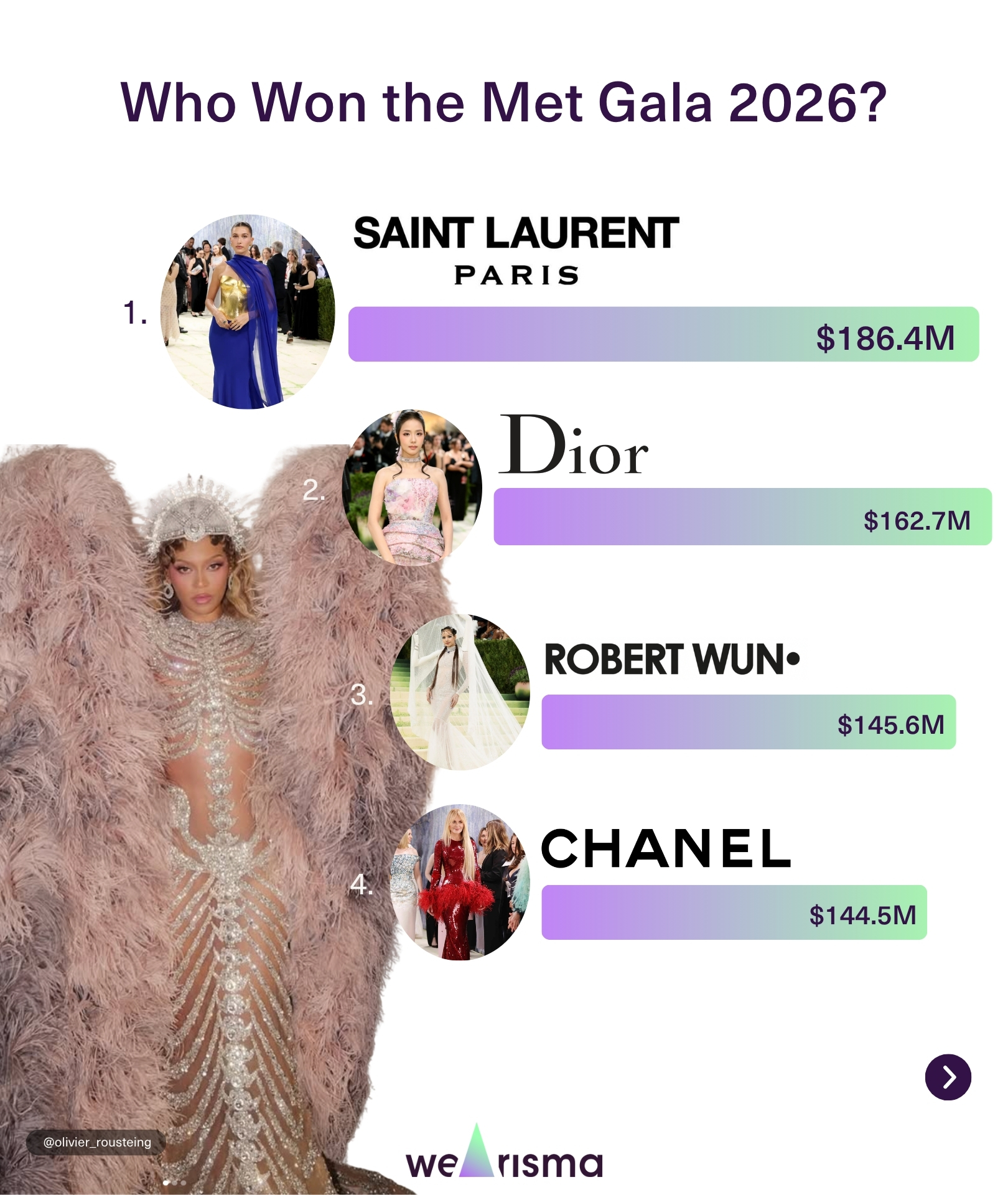
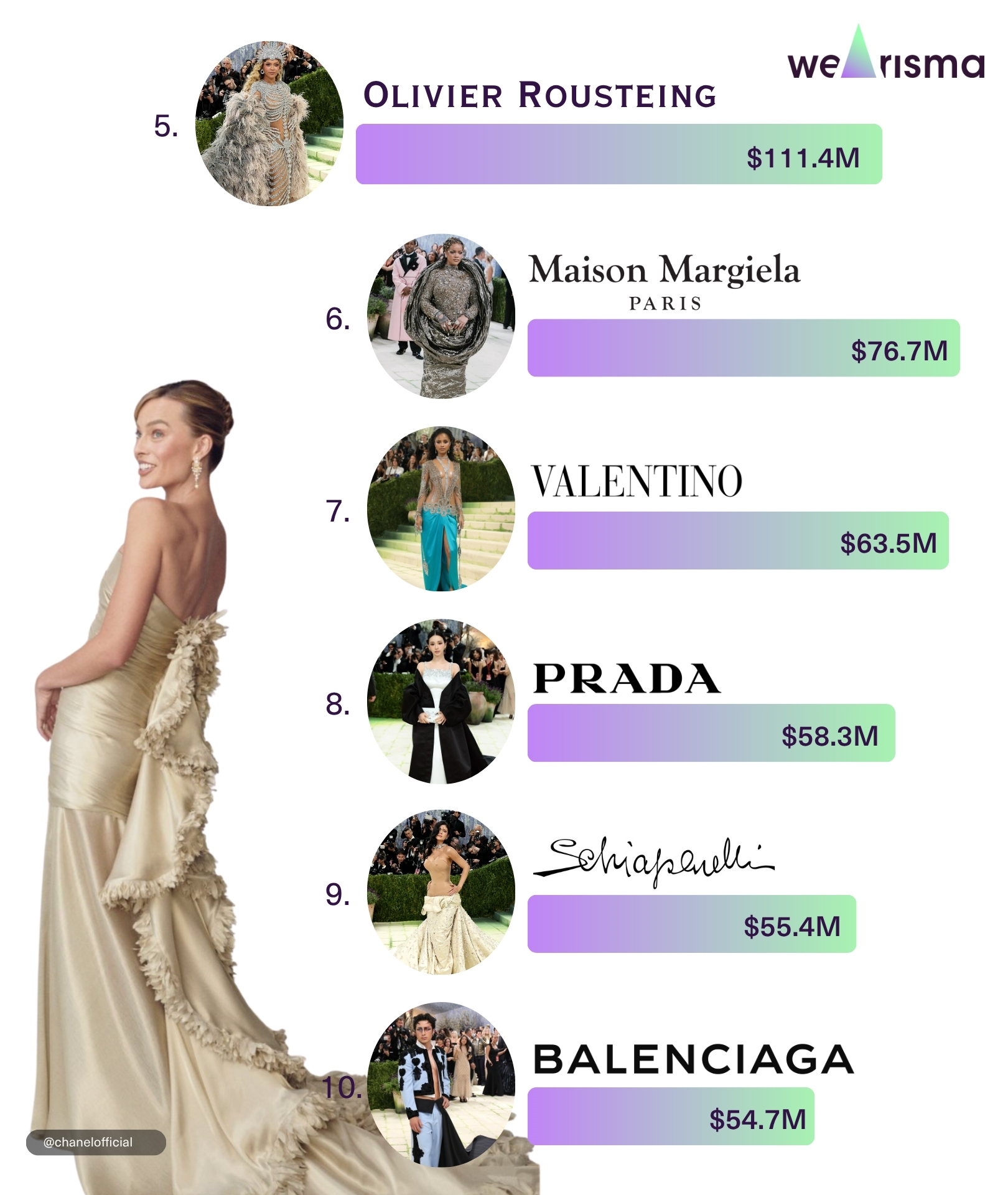
What’s particularly striking this year is Robert Wun’s position at number three – an independent Hong Kong-based couturier placing ahead of Chanel, Prada, and Gucci, dressing 7 celebrities in total including 2 of the most talked about stars of the night Beyonce, and BLACKPINK’s Lisa. This is a landmark result that reflects a broader cultural appetite for designers with a strong creative voice over heritage name alone.
Beyond volume, engagement rate reveals which brands generated genuine audience enthusiasm rather than just reach. The leaders this year – Valentino (35.72%), Prada (34.67%), and Thom Browne (33.60%) – point to smart, selective dressing strategies. Fewer placements, higher impact.
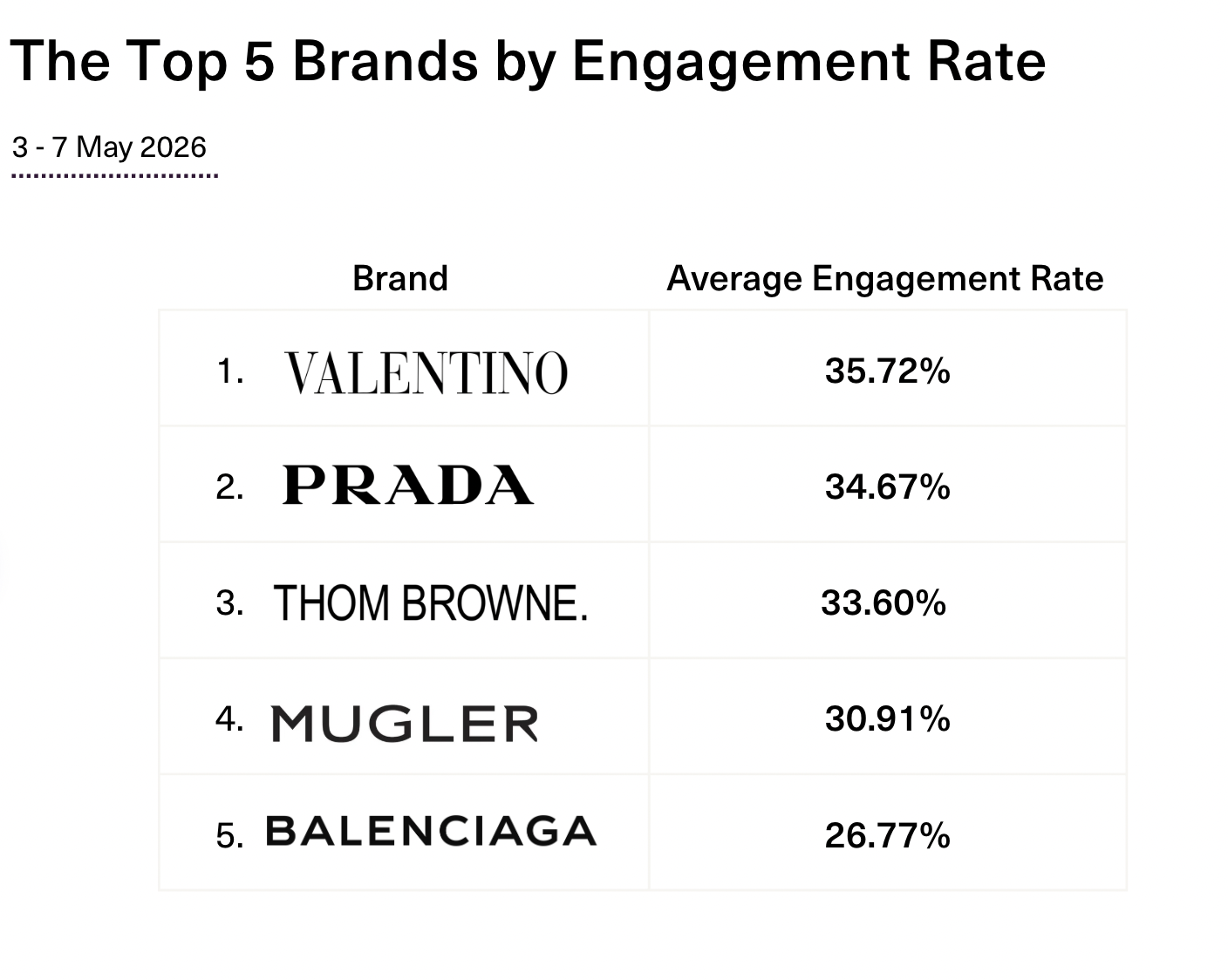
Valentino’s dominance came down to two looks that owned the night. Tyla’s peacock-inspired gown and Odessa A’Zion’s custom Valentino dress together drove the brand’s exceptional rate, with MTV UK’s Odessa post becoming the single highest-performing post in the entire dataset at a 402% engagement rate. When your placements become the visual shorthand for the whole event, the numbers take care of themselves.
Prada’s strength was range. Hunter Schafer drove huge engagement through a widely-covered look that drew comparisons to Gustav Klimt, while Karina of aespa brought an entirely different audience – K-pop fandoms – adding a second major spike. Two celebrities, two worlds, one brand threading them together.
Thom Browne punched well above its post volume by dressing celebrities who sparked conversations, not just coverage. Dwayne Johnson’s kilt, and his explanation that “the most masculine men wear skirts” in Polynesian culture, turned a fashion moment into a cultural one, while Finn Wolfhard’s Met debut generated a remarkable engagement rate from very few posts, a ratio no other brand came close to matching.
FYI: Our platform captured all EMV data and Engagements from The Met Gala, interactions that look beyond traditional tags, vanity metrics, and brand mentions alone. Our numbers paint a true and accurate picture of campaign activities and coverage at this year’s event.
The 2026 Met Gala was remarkable on every level. Among the spectacle, five brands truly pushed the envelope. Here’s our roundup.
Saint Laurent is the undisputed champion of the Met Gala 2026, earning an EMV of $186.4 million – the highest of any brand tracked this year.
The house achieved this through a combination of extraordinary scale and quality: sustaining a 12.24% average engagement rate throughout. Key attendees dressed by Saint Laurent included Hailey Bieber and Rosé (Rose Park of BLACKPINK), whose posts alone generated millions of engagements each. Saint Laurent’s strategy of dressing a wide spectrum of talent – from global pop icons to fashion insiders – proved decisive in accumulating both reach and resonance.
Dior comes in at second place with an EMV of $162.7 million and 226.1 million engagements – results built on some of the most high-profile individual appearances of the night.
Sabrina Carpenter was among Dior’s most impactful ambassadors at this year’s event, generating $12.3 million in media value across just four posts. Jisoo Kim (BLACKPINK) also delivered exceptional results for the house, with her single Dior appearance generating $4 million in media value from her 80 million Instagram followers. The K-pop connection was clearly a cornerstone of Dior’s Met Gala strategy, and the numbers validate that approach entirely.
Robert Wun’s performance at the 2026 Met Gala is the story of the year. The independent Hong Kong-based couturier earned $145.6 million in EMV – placing ahead of Chanel, Prada, Gucci, and every other heritage luxury house tracked. That figure was driven by two major moments: BLACKPINK’s Lisa’s gown and Beyoncé’s second look.
Robert Wun’s intricate, sculptural designs captivated audiences in a way that few brands, independent or otherwise, have managed at this event. This result signals a profound shift: in the social era, couture craftsmanship combined with genuine cultural resonance can outperform legacy brand equity.
Chanel secured fourth place with $144.5 million in EMV, exceptional numbers that, in any other year, would have secured a top two finish.
Chanel achieved the highest average engagement rate (12.66%) among the top four brands. Two key moments drove this: Mathieu Blazy’s Met debut as Creative Director, and the house dressing high-profile figures including new ambassador ASAP Rocky and Anna Wintour herself. These placements generated strong engagement rather than sheer post volume.
Olivier Rousteing, delivered a strong performance with $111.4 million in EMV and 154.4 million engagements, making Rousteing one of the few creative directors to command his own tracked brand line in our data.
Olivier Rousteing’s presence was both culturally visible and commercially impactful. Rousteing’s personal brand magnetism continues to be a multiplier for the house’s earned media footprint at major events.
Behind every EMV number is a name. Using WeArisma’s mention tracking – capturing hashtags, handles, and direct references – we can see exactly which celebrities drove the most conversation for each of the top brands.
Hailey Bieber led the way, generating $3.1M in EMV from her own posts alone, with Rosé close behind at $3.0M. Connor Storrie also featured, a rising name whose Saint Laurent debut at this year’s Gala cut through well beyond his follower count. A deliberately eclectic mix of pop royalty, emerging names, and fashion insiders, and it paid off.
Sabrina Carpenter was Dior’s standout individual performer, driving $7.6M in EMV from her own posts, the highest of any celebrity-to-brand pairing in this group. Jisoo from BLACKPINK followed with $4.0M, making the K-pop constellation around Dior impossible to ignore.
The most striking finding in the entire dataset. Robert Wun’s biggest celebrity drivers were Lisa from BLACKPINK and Beyoncé, two of the most influential names on the planet. That association, even organically, is what $145.6M in EMV looks like.
Jennie from BLACKPINK led the conversation, ahead of Nicole Kidman, A$AP Rocky, and Anna Wintour. Chanel’s audience skewed both fashion establishment and global pop, a rare combination.
Beyoncé dominated here, her presence at this year’s Gala clearly amplifying Balmain’s visibility significantly across the board.
Beyond the brands, certain individuals drove exceptional media value through their Met Gala appearances and posting on their own social channels.
aespa topped the individual rankings with a combined $16.4 million in media value across Instagram and TikTok, representing both Gucci and Prada. Their 27 posts generated 41.6 million engagements, a staggering per-post impact that underlines K-pop’s dominance in fashion influence.
Kylie Jenner delivered $12.7 million for Schiaparelli from just two posts, leveraging her 385 million Instagram followers.
Sabrina Carpenter was close behind at $12.3 million across Dior and Versace.
Dwayne Johnson generated $7.1 million in combined media value for Thom Browne, proving that crossover celebrity, beyond traditional fashion circles, can drive significant results.
The continued rise of Korean celebrities as individual influencers was one of the clearest themes of 2026. aespa, Karina, Jisoo Kim, Rosé, and NINGNING collectively drove tens of millions in media value and engagements across multiple houses, cementing K-entertainment as an indispensable pillar of any serious Met Gala brand strategy.
Instagram remained the dominant platform for media value, generating $636.1 million from 16,448 posts across 2,176 creators.
Facebook came in second at $491 million – driven primarily by major media publishers reaching broad audiences.
TikTok ranked third for media value at $296.5 million. The platform’s ability to turn Met Gala content into cultural conversation is unmatched.
YouTube contributed $43.9 million, largely through long-form coverage and red carpet recap content from major editorial outlets.
This split tells an important strategic story: Instagram builds monetisable brand equity, TikTok builds cultural volume. Brands that activated on both platforms, like Saint Laurent, Dior, and Robert Wun, captured the full spectrum of value.
The 2026 Met Gala exceeded every benchmark. $1.49 billion in total EMV. 2.23 billion engagements. And a performance from an independent designer that will be talked about in fashion marketing circles for years.
The clearest lesson from this year’s data is that cultural authenticity – a designer with a genuine creative vision, placed on the right person, photographed at the right moment – can outperform even the deepest marketing budget. Robert Wun proved it. Valentino’s 35.72% engagement rate proved it. The K-pop generation proved it.
We can’t wait to see what 2027 brings.