Beauty in Asia: Micro or Macro Influencers? (South Korea and Japan Edition)

The Asian beauty market, valued at over $149 billion, is heavily influenced by digital channels. From January to September 2017-2018, Japan saw a slight increase in engagement among influencers with 1 million+ followers, while South Korea experienced higher engagement with those under 20,000 followers. Brands should target micro-influencers in South Korea and top influencers in Japan for 2019.

Published On: September 20, 2018

Insights into Beauty Influencer Engagement in Asia

The Asian beauty market is defined by its ability to swiftly launch new brands, new products and new technologies charged by the adoption of the digital world which is completely reshaping the retail market. With over 9.9% of beauty product sales occurring online in Asia, digital channels have lowered barriers to entry, enabling consumers from all generations to purchase their desired beauty products anywhere. With an increase of over 6.4% in beauty and personal care products in Asia in 2017, the beauty market has reached over $149bn in sales and today represents one of the most valuable segments of consumer goods worldwide.

Consumer interest in Asia goes beyond product information and pricing. With one of the highest levels of internet penetration on Earth, savvy shoppers are looking online for product usage videos, online referrals, and bespoke information through key influencers online. Therefore vlogs, editorial blogs, tutorials, consumer reviews, and social media channels have become an important arena for consumer decision-making – and companies must ensure their online presence remains satisfactory since consumers see the internet as a crucial channel for communication and knowledge.

Two of Asia’s key players in the beauty space are South Korea and Japan, both home to dozens of up and coming beauty brands as well as established conglomerates. In this week’s blog, we will look into the engagement rates of beauty influencers in South Korea and Japan across January-September 2017-2018 to see if there have been any changes.

Wearisma Insight

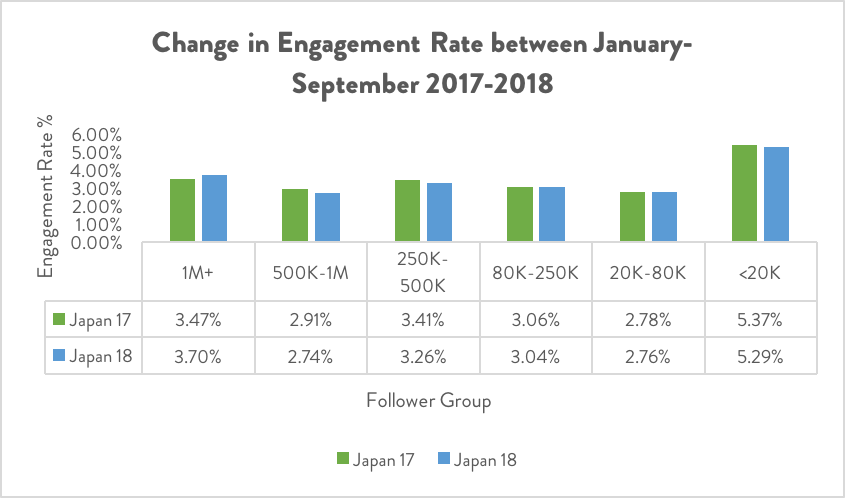
Japan January-September 2017-2018

South Korea January-September 2017-2018
Starting off with Japan, we can see that engagement rates for the majority of groups are roughly the same without little change. The one group that has seen changes in engagement rate is the 1 million+ follower segment which has seen an engagement rate change from 3.47% in 2017 to an increase of 3.70% in 2018.

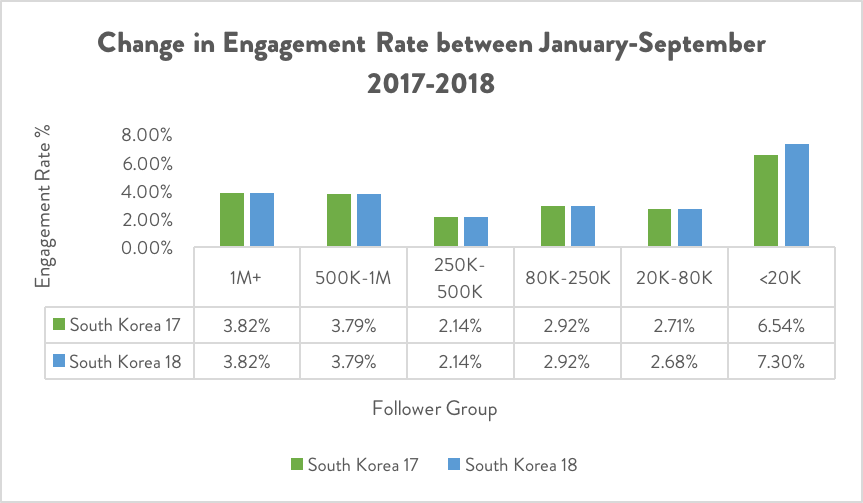
Moving onto South Korea, similarly, there are very few changes in engagement rate among the different segments within 2017-2018 (January-September). However interestingly, on the polar opposite end to Japan, the one segment South Korea has seen a change in is the <20K follower segment which has seen an increase in engagement from 6.55% in 2017 to 7.30% in 2018.

Brands and agencies can use the data above when deciding their 2019 pan-Asian influencer strategy. It may be worth looking into investing in micro influencers in South Korea compared to big celebrity influencers in Japan within the coming year.
Resources

Stay Ahead with the Latest Creator Economy Intelligence

Access timely cultural trends, strategic creator guidance, and industry best practices.

Cannes Lions 2026: The Creator Marketing Questions Every CMO Will Be Asking

Cannes Lions has always been where the industry takes stock, not just of the work, but of where the money is going and why. This year, creator marketing will be front and centre. Not because it’s new, but because the ground underneath it is shifting in ways that are forcing brands to fundamentally rethink how they plan, measure and value creator partnerships. 

Here are the three topics we expect to define the week.

Media & Entertainment Influence Index 2026

The top 100 media and entertainment brands across video streaming, audio streaming, and content creation generated $63.4B in total Earned Media Value in 2025, up +7.0% YoY. Growth is uneven across sub-sectors, video streaming surged while audio streaming declined sharply, platform dynamics are shifting fast, and a handful of breakout brands are rewriting what influence looks like in entertainment.

TikTok grew +70.2% YoY and is rapidly closing the gap on YouTube as the dominant entertainment influence platform. YouTube remains #1 at $32.6B but declined -11.3%, while Instagram grew +4.4% to $13.3B. Facebook nearly doubled to $7.3B (+98.9%), making media and entertainment one of the few categories where four platforms are genuinely competing for share.


Beauty Influencer Marketing Benchmarks for 2026

The Beauty Influencer Marketing Benchmark Report: Engagement Rate, Earned Media Value, and Defining What “Good” Looks Like in 2026

Coty: Client Success Story

Stay Ahead with WeArisma Intelligence

Join our community and get cultural insights, creator strategy guides, and real-world best practices.

  • See who’s shaping culture, and how.
 
  • Access practical guides and strategy tools.
 
  • Understand how top brands are growing ROI and productivity.
 
  • Read expert takes on what’s next.

Join the Community